Visible veins around the nose, persistent redness across the cheeks, and tiny spider-like vessels on the chin are among the most common skin concerns we see. While often called broken capillaries, these visible vessels are actually dilated micro-vessels sitting close to the surface of the skin. They are entirely benign in most cases, but they rarely fade away on their own once they appear.
Dye-VL is one option to discuss for visible facial vessels. A clinician can assess the cause of your redness, whether pulsed light is appropriate, and the possible risks.
Understanding Facial Telangiectasias and Vascular Redness
In clinical terms, visible facial vessels are known as telangiectasias. These tiny blood vessels, primarily venules, capillaries, and arterioles, sit within the upper layers of the dermis. When they function normally, they expand and contract to regulate blood flow and skin temperature. Over time, structural changes in the vessel walls can leave them permanently dilated, allowing blood to remain visible through the epidermis.
Facial vascular concerns typically show up in two main patterns:
- Isolated Spider Veins and Linear Vessels: Distinct, branching, or linear red and purple lines, frequently appearing around the base of the nose, across the nasal bridge, or along the high points of the cheeks.
- Diffuse Vascular Redness: A broader background flush, commonly associated with erythematotelangiectatic rosacea, sun damage, or sensitive reactive skin.
Living in the Pacific Northwest exposes our skin to alternating damp cold, wind, and intense seasonal ultraviolet radiation. Sun exposure remains one of the primary drivers of vascular breakdown, as ultraviolet radiation degrades collagen and elastin fibers that normally support vessel walls. When that structural framework weakens, micro-vessels lose their elasticity, expand, and stay dilated.
Why Perinasal Veins and Broken Capillaries Persist
The area around the nostrils and mid-face is especially prone to stubborn telangiectasias. Every time you sneeze, blow your nose, experience an allergic flare, or step into a hot shower, blood rushes to this delicate vascular network.
Topical skincare has clear limitations here. While gentle formulations can calm surface irritation and reinforce your moisture barrier, no cream or serum can repair a vessel wall that has lost its tone. Once a capillary has stretched and settled into a permanently dilated state, only targeted energy can signal the vessel to collapse and allow the body to clear it away naturally.
The Mechanism of Targeted Dye-VL Vascular Therapy
At Premier Med Spa of Lake Oswego, our approach to facial vein treatment uses advanced Dye-VL technology on the Alma platform. Dye-VL is a specialized form of intense pulsed light that uses precise filtration to concentrate optical energy into the exact wavelengths absorbed by vascular targets.
Unlike traditional broad-spectrum light devices that disperse energy across wide, uncalibrated bands, Dye-VL is specifically tuned to interact with the chromophores inside your blood vessels.
Selective Photocoagulation: Protecting the Surrounding Epidermis
The fundamental principle behind this treatment is selective photothermolysis. Hemoglobin, the protein inside red blood cells, has specific light absorption peaks. When the Dye-VL handpiece pulses, hemoglobin absorbs that light energy and converts it instantly into controlled heat.
This localized thermal spike gently coagulates the blood inside the vessel, causing the delicate vessel walls to collapse and seal shut. Because the light is calibrated to match hemoglobin rather than the surrounding melanin or water in your skin, the overlying epidermis and adjacent tissue remain unharmed. Over the following weeks, your body’s natural scavenger cells and lymphatic pathways break down and reabsorb the closed vessel remnants.
Precision Filtering for Vascular Targets
Broad-spectrum intense pulsed light devices emit light across a wide band (often from 400 nm to 1200 nm). While effective for general skin tone, broader bands require higher total energy outputs, which can increase surface heat on the skin.
Dye-VL uses light filtered to 500–600 nm. The technique aims to heat visible vessels. Surrounding skin can also react, and treatment can cause redness, swelling, burns, or changes in pigmentation.
What to Expect During Your Facial Vein Treatment
Knowing what happens during your appointment helps remove uncertainty from the process. Every treatment at our Lake Oswego clinic begins with a clean, makeup-free face and a thorough assessment of your vascular pattern.
Treatment Sensation and Session Timing
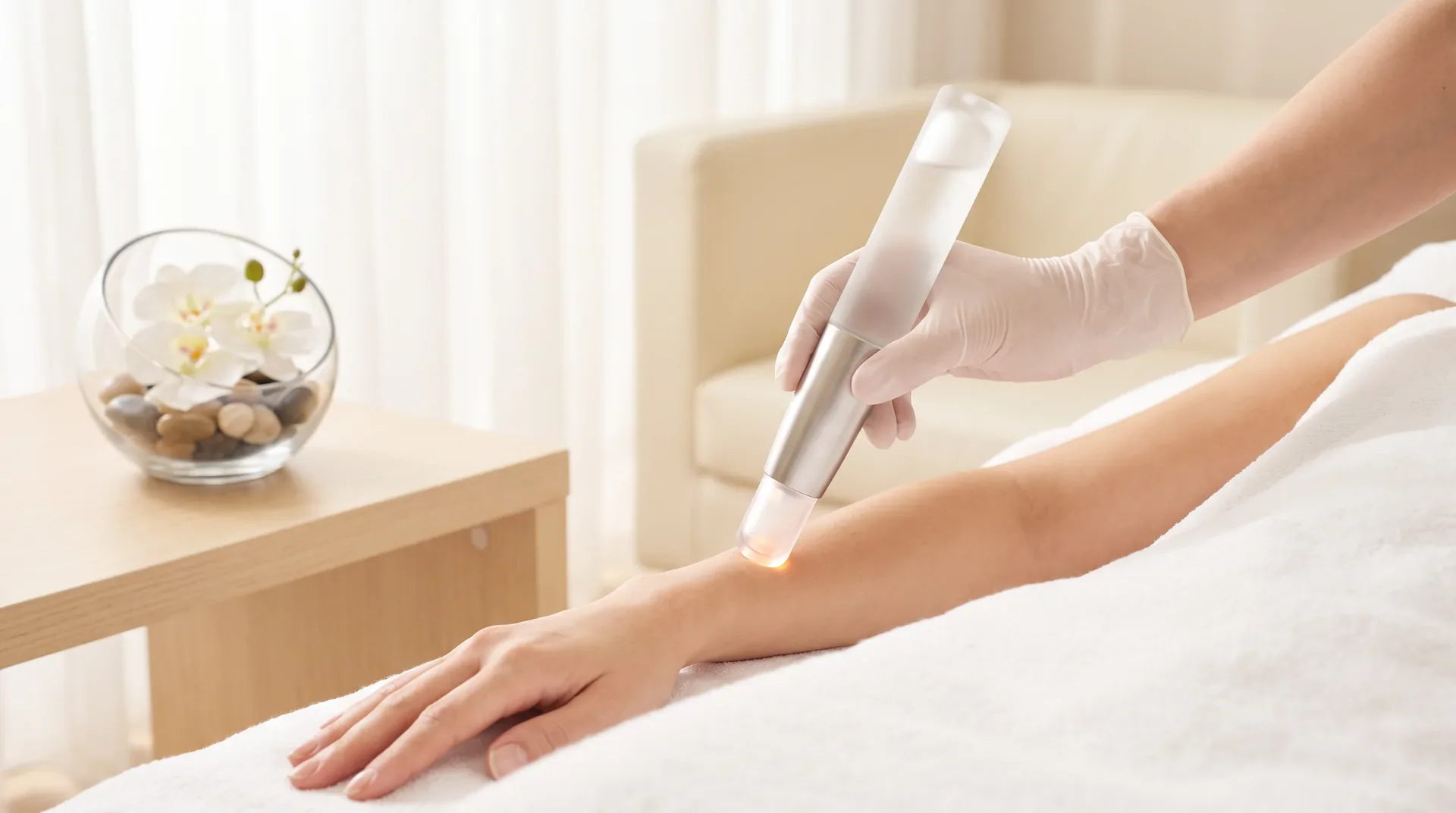
Before treatment begins, your provider will apply protective eyewear and a clear, cooling optical gel to the skin. The handpiece is placed gently against the target area, delivering swift, calibrated light pulses.
Most patients describe the sensation as a brief, warm snap or mild tingling. It is easily managed without numbing agents, which are intentionally avoided because topical anesthetics constrict blood vessels and temporarily hide the very targets we are trying to treat.
Treatment time depends on your treatment goals:
- Single, isolated vessels: A few minutes for isolated perinasal or cheek veins.
- Full-face vascular redness: Roughly 45 minutes to an hour for broader concerns involving widespread flushing or mixed vascular and pigmented spots.
Post-Care and Natural Vessel Reabsorption
Following your session, downtime is minimal, and you can return to normal daily activities immediately. Treated skin will often feel sun-warmed, accompanied by mild redness or temporary swelling that resolves on its own over the next several hours to a couple of days.
In some cases, targeted linear veins may darken slightly or take on a faint grayish hue immediately after treatment. That is a normal clinical sign that selective photocoagulation has occurred. Over the subsequent weeks, the vessel gently fades as the body clears the cellular debris.
Post-care is straightforward but vital:
- Strict Sun Protection: Shield the treated area with broad-spectrum mineral sunscreen and wide-brimmed hats. UV exposure during recovery can trigger unwanted pigment changes.
- Avoid Excessive Heat: Skip saunas, steam rooms, rigorous workouts, and very hot showers for the first 24 to 48 hours to avoid re-dilating healing vessels.
- Gentle Skincare: Stick to mild cleansers and barrier-supporting moisturizers while your skin resets.
Results build over a series of visits, and individual results vary depending on vessel size, skin tone, and depth. A personalized series is mapped during your initial consultation.
Integrating Vascular Care into Your Long-Term Skin Health Plan
Many patients who present with telangiectasias also notice other signs of environmental aging, such as sun spots, freckles, or uneven tone. Because vascular and pigment irregularities often share the same underlying cause (sun damage), they frequently respond well to a comprehensive treatment strategy.
Our full menu of laser and light treatments allows us to design plans tailored to your specific tissue qualities. For example, our IPL Dye-VL therapy can be utilized to address both vascular erythema and stubborn brown dyschromia in the same treatment course, clearing up mottled discoloration for a noticeably more uniform complexion.
Some treated vessels may become less visible. The response varies, and new vessels may appear over time.
Physician-Led Vascular Consultations in Lake Oswego
Treating facial blood vessels safely requires precision, proper device calibration, and a deep understanding of facial anatomy and skin phototypes. At Premier Med Spa of Lake Oswego, all vascular treatments are conducted within a physician-led practice under board-certified medical direction.
During your vascular consultation, our providers will:
- Examine your vascular patterns and distinguish between isolated telangiectasias, rosacea-related erythema, and deeper venous networks.
- Evaluate your Fitzpatrick skin type to select the safest, most effective device settings.
- Review lifestyle habits, skincare routines, and triggers to help you protect your investment.
- Map out an honest, realistic treatment plan detailing expected session counts and maintenance recommendations.
Whether you are dealing with a few stubborn vessels around the nose or widespread redness across your cheeks, targeted vascular light therapy offers a clinically grounded path back to clear, comfortable skin.